


Company Street Chronicles – February 2017
Millenium Movements and Leather Goods
by Monique Clendinen Watson
The history of the world is the history of migrations, of people moving from one place to another, alone, with family, in small groups or in mass, from one island to another, for one reason or another, across deserts or continents, across rivers or streams, across oceans and seas. So too, is the history of our little island of St. Croix, known of course for its seven flags, but more intimately understood as a place where people have come and gone in freedom or bondage, for money or conquest or love, for a different or better life, in search of food, trade or safe-haven or simply, a good time.
Virgin Islands historian, Dr. Aimery Caron points out in his book The Amerindians & their Legacy in the Virgin Islands that the first aboriginal inhabitants moved north from South America, possibly the Guianas, through a then-connected Trinidad up the Antillean chain to St. Croix. Known as Hahi Hai, or in modern spellings Ay-Ay, St. Croix, “located at that point where the Gre ater Antilles to the west and the Lesser Antilles to the east meet held well-established settlements of four distinct peoples for three and a half millennia before the encounter with the Spaniards in 1493.” The best known of these groups, which were also found on Puerto Rico, Vieques, Culebra and the other Virgin Islands, to include St. Thomas and St. John are of course, the Taino, known as Arawaks for those of us who went to school in the 70s, and the Kalina, best known as Caribs, or Island Caribs. Evidence of their lives have been found at 118 sites throughout St. Croix in places like Salt River, Prosperity, St. George, and according to some, the town of Christiansted, and possibly, Company Street. At the very least, Company Street has been home to collections of aboriginal inhabitant artifacts, one, the Folmer Andersen collection, is part of the National Park Service’s Christiansted National Historic Site and another, is part of the St. Croix Archaeological Museum at #6 Company Street in the Apothecary Courtyard. According to www.stcroixarchaeology.org/, Andersen was a Dane who managed the Bethlehem Sugar Factory at the time of the Transfer and who collected a large number of aboriginal artifacts which were turned over to the National Park Service after his death. The Folmer Andersen collection will be featured this summer on St. Croix when the St. Croix Archaeological Society hosts the 27th Congress of the International Association of Caribbean Archaeologists from July 24 – 27.
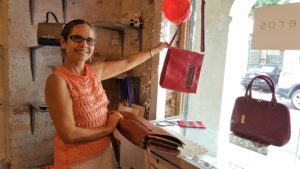
Ingrid White Camacho displays leather bag with aboriginal art
Ingrid White Camacho first came to St. Croix from Connecticut for love, in the post Hugo rebuilding of the 1990s. She followed her first husband, who came as a project manager for a condominium project. She admits that her first impressions of the island, seen first via a VHS tape, were not great as the destruction of the hurricane was massive. However, the lure of the sea, the weather and lifestyle soon made her realize that she was “happy to be here.” Since then, she has worked as a realtor, a translator and a teacher in the community.
It was another centennial disrupter, the closing of the HOVENSA refinery, that prompted Ingrid to open Cueros, a leather store, at 55 Company Street. “I retired from teaching, and I was searching for something to do, when I realized that St. Croix no longer had a leather store, and I could bring leather from the factories in my native Colombia to sell on St. Croix.”
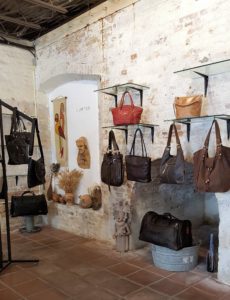
Aboriginal art and leather bags on display at Cueros
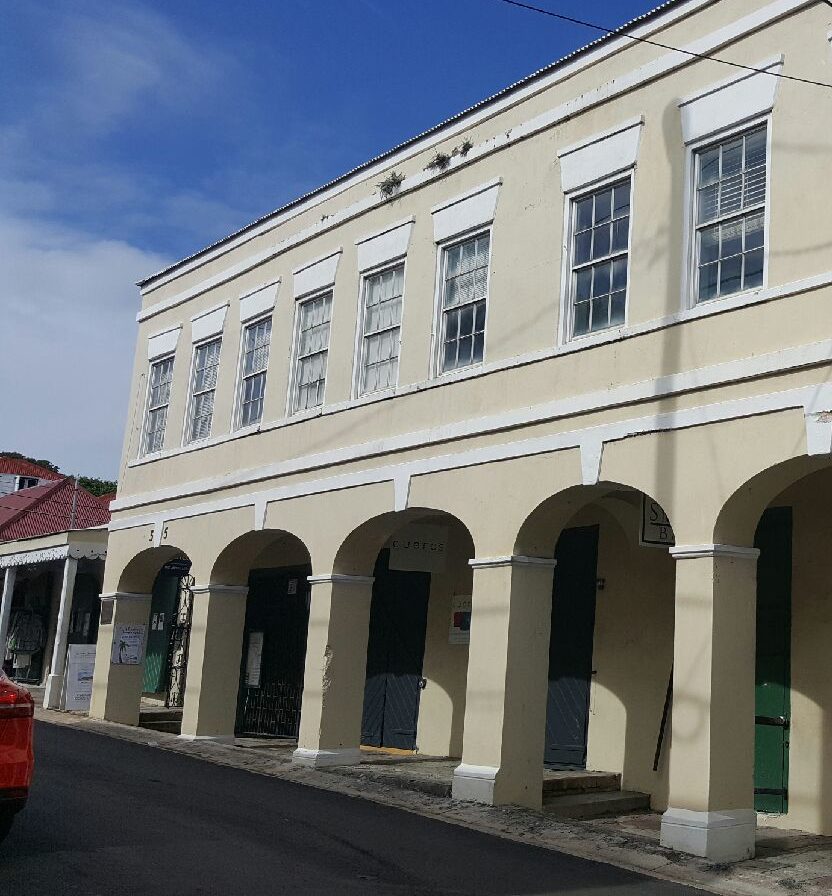
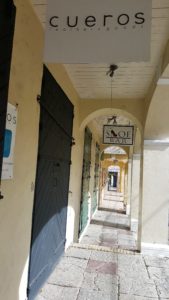
Cueros is located on Company Street, under the covered sidewalk, on the right side, walking up town in what appears to be, because of the presence of an old oven-like space in the store, the kitchen section of a classic first floor of a Crucian style brick and stone masonry building. Ingrid of course has transformed the interior with paint-whitened, exposed brick serving as the backdrop to the elegantly placed bags, purses, briefcases, and backpacks found throughout the store. Placed artistically between the leather goods are aboriginal masks, statuettes, and ceramics of the Wayuu people, the largest aboriginal group of her native Colombia. The Wayuu inhabit the desert-like Guajira peninsula shared by the countries of Colombia and Venezuela. Like their fellow aboriginal people on St. Croix, the Taino and Kalina, the Wayuu resisted the incursions of the Spanish colonists, and were never subjugated by them. At Cueros, Ingrid also displays and sells the weaving and crochet work of the Wayuu women, which are used as bag straps or inset into the leather for a unique look. The Wayuu women support themselves through this folk-art form. At Cueros, Ingrid also features handbags designed by a friend in Italy, and Guyana made flip-flops, there are belts and shoes and all things leather.
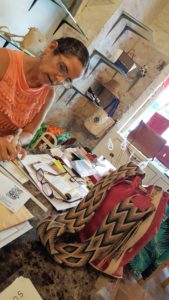
Wayuu women weave art adorns leather bags
Ingrid is hopeful about the economy of St. Croix and while the journey back to the vibrant days of the pre-HOVENSA closing has been slow, she believes that the island has much to offer in the richness of its history, environment and culture. She believes that once potential visitors understand more about St. Croix, they will want to visit. While snowbirds and tourists wandered in an out of the store during my visit to Cueros, Ingrid said she realized at the beginning that her main customers are local people. “If I want to survive in business, then I must serve local people,” she said. “My prices are realistic. I like seeing the reaction of my local customers when they look at a beautiful leather bag or belt and realize, “Oh, the price is not bad.” While I was there, a local customer also came in looking for a birthday gift for her husband and happily found a leather wallet. She too, expressed optimism that the St. Croix economy was on the mend.
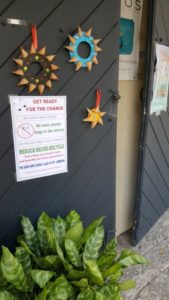
Aboriginal art and environmental reminder
Ingrid taught Spanish at the Good Hope School on St. Croix for many years and particularly likes it when former students come in to Cueros to buy leather goods. “As a teacher in this small community, I get to see my students all grown up, coming back to the island to start businesses or visit their parents. I walked into a restaurant and there was one of my students wearing a leather backpack from my store, he looked like a model, so I took a picture of him and he is featured on my Facebook page.” Her love of St. Croix and its people kept her here with her children when her first husband returned to the mainland. She is now married to Judge Miguel Camacho who has a migration story of his own. He is from a Vieques-St. Croix family, grew up in New York and returned here to work in the legal profession.
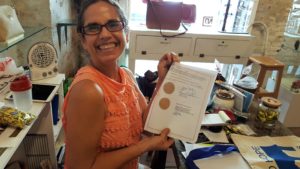
Proudly displaying the new no plastic bag law
If you walk down Company Street, you can sometimes find Ingrid chatting with her fellow storeowners. Always looking for ways to promote the island and Company Street, she organized the Christmas block party in hopes of bringing more people and sales to the town on a sleepy December afternoon. It was her drive to make things happen that got her to organize her students at Good Hope to start the movement to say no to plastic bags. “It took 9 years, but I am so proud that what began as a homeroom project, where the students researched and designed the logo for the campaign, and wrote letters to lawmakers resulted in signed legislation.” She proudly displays a copy of the law in Cueros and fields calls from customers wanting to know where they can get canvas bags.
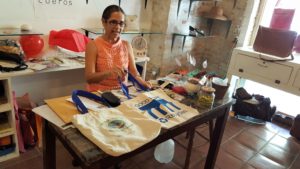
The recycling project that started it all.
You can contact Ingrid at Cueros at 850-512-3525 or follow her on Facebook @STXCUEROS. To learn more about the aboriginal people of St. Croix and the Caribbean, I recommend Dr. Aimery Caron’s The Amerindians & their Legacy in the Virgin Islands. I found my copy at the Caribbean Genealogy Museum on St. Thomas www.cgl.vi/. I am sure there are copies at libraries in the U.S. Virgin Islands www.virginislandpubliclibraries.org or at the St. Croix Landmarks Society at www.stcroixlandmarkssociety.com. Find out more about Folmer Andersen and the St. Croix Archaeological Society at www.stcroixarchaeology.org/. Find out more about the Christiansted National Historic Site at www.nps.gov/chri/. Since the U.S. Virgin Islands is commemorating the 100th anniversary of becoming a part of the American family, you can find information on the Transfer at www.vitransfercentennial.org.
As the world we live in is global and interactive, I would like to hear from you who know and love St. Croix who may have stories, pictures or memories to share about Company Street. Contact me at info@bluegaulinmedia.com or follow me on Facebook @companystreetchronicles or on Twitter @companystreet59.
Monique Clendinen Watson is a writer and public relations specialist who is from the U.S. Virgin Islands and who lives in Virginia. She owns a public relations firm, BlueGaulin Media Strategies, www.bluegaulinmedia.com and is a U.S. Virgin Islands Ambassador. Photos by Monique Clendinen Watson.
© Company Street Chronicles and Bluegaulinmedia are copyright protected. February 2017. All rights reserved.