


Company Street Chronicles
More Than One Thanksgiving Day…
Most people in the U.S. Virgin Islands celebrate Thanksgiving Day at gatherings where everyone is grateful for the blessing of food, family and friendship. Like in other parts of America, a well-seasoned and cooked turkey is the culinary star of the day. Of course, we add Caribbean favorites like potato stuffing, roast pork, seasoned rice, seafood and various dishes that are part of the island heritage and experience of the hosts. Some people attend church, some volunteer and some eat their meals at a favorite restaurant. Everyone is thankful for yet another year of living, remembering those who are no longer with us, welcoming new babies, children and neighbors, and enjoying the slow-down from the business of life.
Up until recently, Virgin Islanders celebrated not one, but two Thanksgiving Days, the other traditionally celebrated on the third Monday in October, which was designated as Hurricane Thanksgiving Day. According to National Geographic and the memories of those of my generation, Hurricane Thanksgiving Day signaled the end of the Hurricane season, when fear of the most ferocious of storms could be put away until the next summer. With Hurricane Thanksgiving Day, people could relax, breathe a sigh of relief and get ready for the upcoming Thanksgiving, Christmas, New Year and Festival that would run straight through to January 6, Three Kings Day, the end of the festive season and the beginning of new year.
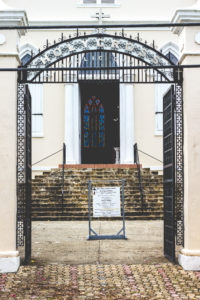
Company Street entrance to Holy Cross Catholic Church
On Company Street, Christiansted, St. Croix, US Virgin Islands, the Holy Cross Catholic Church which was founded in 1755 has seen its share of hurricanes and reasons to hold services on both, Hurricane Supplication Day, celebrated in June at the start of the season to pray to be spared from the destruction of storms and Hurricane Thanksgiving Day, celebrated at season’s end to give thanks for being spared. It has stood witness to two and a half centuries of the tropical devastation of the hurricanes, including those of 1772,1785,1819, and 1837. Historian Isaac Dookhan in his A History of the Virgin Islands of the United States, states that in 1772, “ships in the harbor were thrown ashore and throughout the islands, sugarcane and cotton fields were devastated while many sugar works collapsed. Slave houses and many buildings belonging to the whites were destroyed.” The 1772 hurricane of course is the same one that inspired a young Alexander Hamilton to write a letter that once published, got him noticed and off to his destiny as part of the revolutionary cadre that founded the United States of America. He wrote, “several persons killed and numbers utterly ruined – whole families running about the streets unknowing where to find a place of shelter – the sick exposed to the keenness of water and air – without a bed to lie upon – or a dry covering to their bodies – our harbor is entirely bare.”
Historians note that observance of Hurricane Thanksgiving Day began in 1726, when a St. Thomas pastor began the practice of celebrating a religious service for his congregation to thank the Almighty that the islands, were spared the destruction that can come with each storm. The Virgin Islands and her sisters in the Eastern Caribbean are directly in the travel path of hurricanes which originate off the coast of Africa and blow through on their way to either devastating the North American coast or fizzling out at sea. The celebration of Hurricane Thanksgiving Day spread to other churches and congregations and for many years was an official government holiday, with closed schools and government offices. Recent economic concerns about too many paid holidays has made Hurricane Thanksgiving Day an optional, private observance.
Historian Dookhan notes that the damage from hurricanes are not just, as horrible as it can be, the immediate loss of life, livelihood and property. They often have consequences that affect the future. “The hurricane of 1819 had the long-term effect of convincing many islanders that the future of plantation agriculture was bleak. Finally, the hurricane of 1837…came at a time when plantation agriculture was much depressed and it contributed to the lowering or abandonment of production.” He also notes that the hurricane of November 1867, followed by an earthquake and tidal wave, completed the job of destroying the reputation of St. Thomas as a ’safe-haven.’”
In the early 20th century, hurricanes in 1916 and 1928 devastated St. Croix and left an indelible mark on the generations that experienced them. Many people lost everything they had, and those with little means lost more than most. My grandmother remembered that she lost everything but the clothes she was wearing. She also remembered that Virgin Islanders who lived on the mainland, like Casper Holstein, organized relief efforts that assisted the victims of those storms. Memories of those storms referred to as the “Gale of 16” and the “Gale of 28” were the only experience that several generations of Virgin Islanders had of life-changing storms for 61 years.
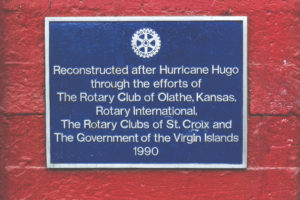
Help from Kansas Rotary Club
And then came 1989 and Hurricane Hugo. By then, only the pastors and a few elder ladies bothered to go to church on Hurricane Supplication of Hurricane Thanksgiving Day. Hurricane Hugo, as this generation well knows came at St. Croix with a fury that had never been seen or felt in a very long time. Its winds which were upward of 250 miles an hour shredded the island, leaving more than 90 percent of its structures roofless and damaged. My family and I, like many of my fellow islanders huddled in a closet as the roof of my home was torn off leaving nothing but sky, wind and rain. We ran for our lives to our SUV, seeking shelter from airborne projectiles. Thankfully, the death toll was low and most people emerged from the experience exclaiming “Thank God for Life!” It took most islanders more than a year to recover and that was with the help of insurance, FEMA, SBA and the Red Cross. Help also came from neighbors and friends and from caring strangers from across the country and the globe like those who got together to restore the Hendricks Vegetable Market on Company Street.
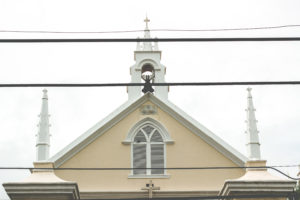
Restored roof of Holy Cross Catholic Church
Holy Cross Catholic Church on Company Street, which bears the same name as St. Croix, (Holy Cross in French), suffered severe roof damage in Hurricane Hugo. It of course has been restored and during a visit to the church last summer, I joined in the recitation of the prayer for protection against the devastation of storms. Other island congregations, I am sure, recite similar prayers and though the services may be sparsely attended by the populace, congregants ask to be spared at the beginning of the hurricane season and thank God for sparing them at the end of it.
Unlike in the time of Alexander Hamilton, most people today survive hurricanes. Early warning systems and federal disaster relief stave off epidemics of malaria and cholera that followed Virgin Islands hurricanes in the 18th and 19th centuries. People work with their neighbors to rebuild or they leave the islands, sometimes never to return. Others come home to the islands they have left to help family and friends and stay or leave again. Just like Hamilton, many Virgin Islands writers have told tales of the terrible storms. Their books can be found at Undercover Books in Gallows Bay www.undercoverbookstcroix.com. or of course at Virgin Islands public libraries www.virginislandspubliclibraries.org.
As the world we live in is global and interactive, I would like to hear from you who know and love St. Croix who may have stories, pictures or memories to share about Company Street. Contact me at info@bluegaulinmedia.com. Photos by Chalana Brown.
Monique Clendinen Watson is a writer and public relations specialist who is from the U.S. Virgin Islands and who lives in Virginia. She owns a public relations firm, BlueGaulin Media Strategies, www.bluegaulinmedia.com and is a U.S. Virgin Islands Ambassador.
© Company Street Chronicles and Bluegaulinmedia are copyright protected. November 2016. All rights reserved.